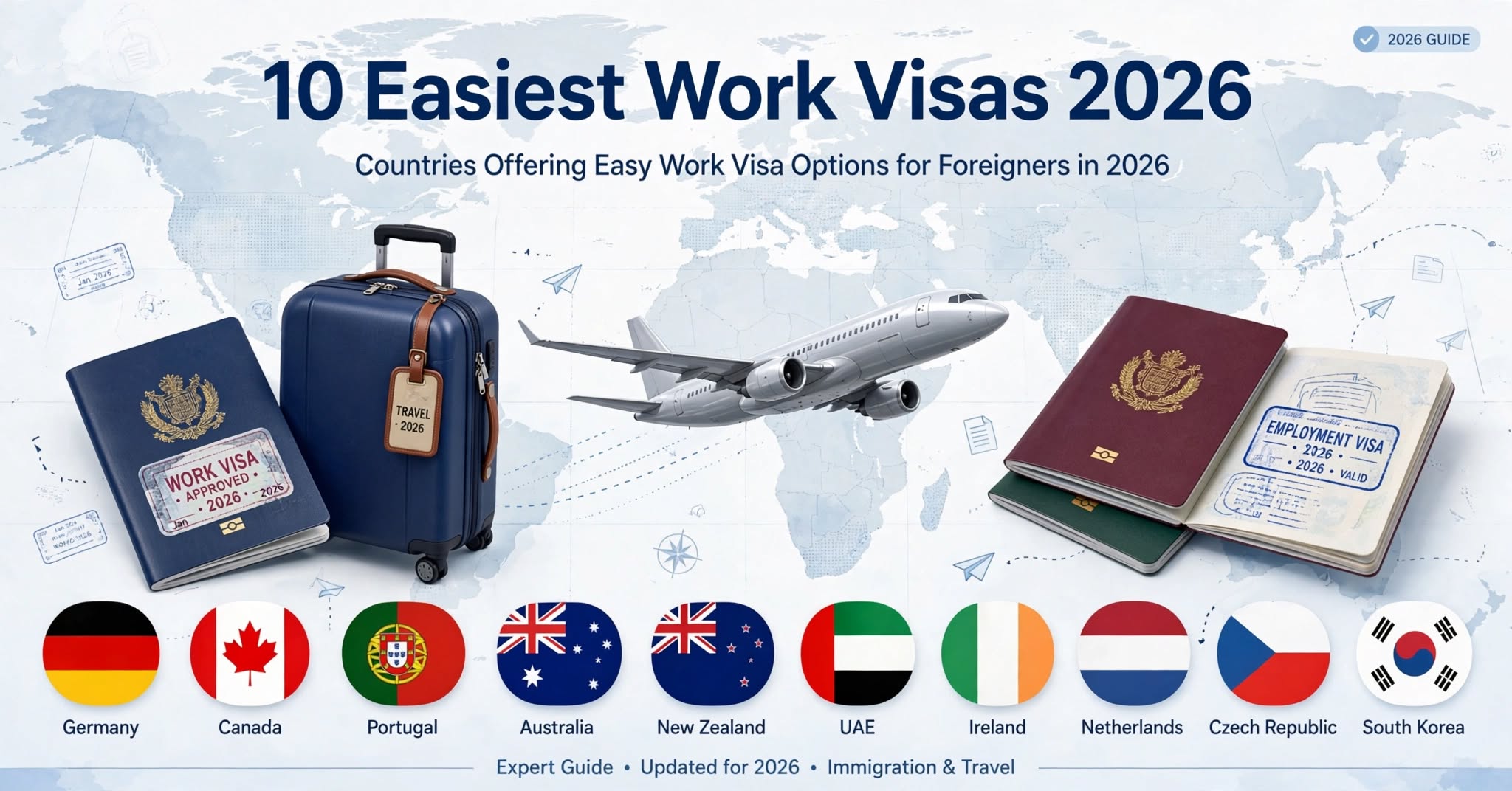
Finding a country that actually wants you to come and work has never been more realistic than in 2026. Labor shortages, aging populations, and booming tech sectors have forced many governments to simplify their immigration systems. Whether you are a skilled professional, a recent graduate, or looking for a career switch, these 10 countries are leading the list for accessible work visa pathways this year.
1. Germany – The EU Blue Card and Opportunity Card Champion
Germany remains one of the easiest work visas in Europe due to high demand for skilled workers and its Skilled Immigration Act.
Why it’s easy in 2026:
Germany now has two parallel tracks that have completely changed the game.
a) EU Blue Card: If you have a university degree and a job offer with a salary of around €45,300 (€41,041 for shortage occupations like IT, engineering, healthcare), you can get a Blue Card in 1-3 months. The big win? You can get permanent residency in just 21 months if you have B1 German, or 33 months without it.
b) Chancenkarte (Opportunity Card): This is the star of 2026. No job offer needed to enter. You need just 6 points from qualifications, language, experience, and age. No salary requirement at entry. It lasts for 12 months and allows 20 hours per week of part-time work while you look for a full-time job. This is the most useful feature of any job-seeker route currently available.
Best for: Engineers, IT specialists, healthcare workers, electricians, and vocational professionals. Germany has simplified visa procedures for non-EU citizens specifically for these roles.
2. Canada – Still the Easiest Path to Permanent Residency
Canada continues to be the preferred destination for skilled workers due to its Express Entry system and Provincial Nominee Programs (PNPs). It plans to welcome over 380,000 permanent residents in 2026.
Why it’s easy:
Unlike most countries where you need an employer first, Canada lets you apply for PR based on your skills.
Express Entry: A points-based system. If you are under 40, have a degree, 1+ years of skilled work experience, and good English (IELTS 7+), you have a strong chance. STEM, healthcare, and trades draws in 2026 have very low cut-offs.
Global Talent Stream (GTS): For those with a job offer. Employers in tech can get a Labour Market Impact Assessment (LMIA) approved in just 10 business days, and you get a work permit in 2 weeks.
Processing time is about 6 months for PR. No other major economy gives you permanent status so fast without first living there for years. Canada is considered one of the most immigration-friendly countries in the world.
Best for: Anyone wanting long-term settlement with family. It is the gold standard for accessible PR among skilled professionals.
3. Portugal – Europe’s Most Accessible Gateway
Portugal has become one of the most accessible countries in Europe for foreign workers.
Why it’s easy in 2026:
Portugal Job Seeker Visa: You get 120 days, extendable by 60 days, to enter Portugal and find a job. You don’t need a job offer to apply, just proof of funds around €5,600 and travel insurance.
Digital Nomad / Remote Work Visa: If you earn 4x the Portuguese minimum wage (approx €3,280/month from foreign sources), you can live in Portugal for a year and renew up to 5 years, then apply for PR.
Tech & Seasonal Visas: Portugal has a very low bureaucracy for hospitality, agriculture, and construction sectors. Employers are used to sponsoring non-EU workers.
Low cost of living compared to Germany or Netherlands makes it ideal for a first EU move.
4. Australia – Points-Based System with High Salaries
Australia, New Zealand, Ireland, Canada, and Singapore offer the most accessible work visas, mostly through skills-based programs.
Why it’s easy:
Australia’s Skill Shortage is critical in 2026.
Skills in Demand Visa (replaced TSS in late 2024): 3 streams – Specialist Skills (AUD 135,000+ salary, fast 7-day processing), Core Skills (most trades and professionals), and Essential Skills. Employer sponsorship is straightforward.
Working Holiday Visa (Subclass 417/462): For under 35s from eligible countries, this is fully online and one of the simplest visas to apply for. You can work and travel for up to 3 years.
Australia also has state nomination programs that add 15 points to your Express of Interest, making PR much easier if you work in regional areas.
5. New Zealand – Work in Nature’s Playground with Fast PR
New Zealand’s Skilled Migrant Category offers long-term work opportunities in high-demand sectors. After working for 2 years, many applicants become eligible for permanent residency.
Why it’s easy:
Accredited Employer Work Visa (AEWV): If an employer is accredited (over 30,000 are), they can hire you without proving they couldn’t find a local. Roles on the Green List (healthcare, engineers, IT, construction) get straight to residence.
Working Holiday Visa: Processed fully online and approved in as little as two weeks for many nationalities.
Iceland, Luxembourg and New Zealand were ranked among the most comfortable countries for expats in 2026 due to high foreign employment rates and integration.
6. United Arab Emirates (UAE) – Zero Income Tax and Instant Visas
The UAE, especially Dubai and Abu Dhabi, is one of the fastest places to get a work permit in 2026.
Why it’s easy:
Standard Employment Visa: Employer does everything. No points, no language test. You get entry permit in 5 days and Emirates ID within 2 weeks of arrival.
Green Visa (5 years): For skilled workers earning AED 15,000+ (∼$4,080), you can self-sponsor for 5 years without an employer. Freelance Visa and Remote Work Visa need only proof of $5,000/month income.
Job Seeker Visit Visa: 60, 90, or 120-day visa to come and find a job, no sponsor needed. You can convert it inside the country once you get an offer.
No PR in the traditional sense, but 10-year Golden Visa for investors, doctors, engineers, and top students is now much easier.
7. Ireland – Tech Hub with 2-Year Critical Skills Path
Ireland is often overlooked but is one of the easiest English-speaking EU countries to get sponsored.
Why it’s easy:
Critical Skills Employment Permit: For jobs paying over €38,000 in IT, pharma, medical, finance, engineering. 90% approval rate, processing in 4-6 weeks. After 2 years on this permit, you can apply for Stamp 4 which lets you live and work in Ireland without a permit.
General Employment Permit: For jobs paying over €34,000 not on the critical list. Also employer-sponsored but has more flexibility.
With Google, Apple, Meta, Pfizer, and hundreds of EU HQs in Dublin, visa sponsorship is standard practice. English-speaking environment means no language barrier.
8. Netherlands – The Orientation Year is a Game Changer
Why it’s easy:
Highly Skilled Migrant Visa: If you earn €4,800/month (under 30: €3,500), any employer who is a IND sponsor can hire you. No labor market test. Decision in 2-4 weeks.
Orientation Year (Zoekjaar): If you graduated from a top 200 university in last 3 years, you get 1 year to live in Netherlands and find a job as highly skilled migrant. You can work freely during that year.
Opportunity Card Model: Like Germany, Netherlands allows part-time work while searching.
Amsterdam, Rotterdam, and Eindhoven have massive English-speaking job markets, especially for tech.
9. Czech Republic and Poland – Easiest EU Entry for Non-Highly Skilled
Poland and Latvia are currently among the easiest due to less restrictive documentation and employer sponsorship opportunities.
Why the Czech Republic is easy:
The Czech Republic offers free or under €50 visa costs and is actively recruiting from Asia and Africa for manufacturing, automotive (Skoda), logistics, and IT.
Employee Card: Single permit combining residence and work. Employer applies, you attend interview. Processing 60-90 days.
Poland offers similar: Work Permit Type A is issued in 2-4 weeks, and many agencies hire warehouse workers, drivers, welders with basic English. After 5 years, EU long-term residence.
These countries are best if you don’t have a university degree but have work experience.
10. South Korea and Singapore – Asia’s Fast-Track Tech Visas
Below are 10 countries offering easy work visas for Africans, including Estonia, South Korea, Singapore, and Germany.
South Korea: The new K-Culture and E-7-4 Skilled Worker points system in 2026 makes it much easier. If you have a job offer in manufacturing, shipbuilding, or tech and score 200+ points (age, Korean language TOPIK, salary), you get an E-7 visa. The country is desperate for foreign workers in factories outside Seoul.
Singapore: Best overall for high salaries in Asia. The Employment Pass (EP) requires SGD 5,600+ salary. The new COMPASS points system is transparent – you get points for qualifications, diversity, and shortage skills. Processing is 10 days. No age limit like Australia.
Singapore, along with Canada, UK, Australia, and New Zealand, has established employer sponsorship systems and ongoing labor shortages.
How to Increase Your Chances in 2026:
- Target Shortage Lists: Every country above publishes a shortage occupation list. If your job is on it, your visa is 50% easier.
- Learn Basic Language: Even A2 German for Germany or TOPIK 2 for Korea adds 20 points.
- Use Job Seeker Visas: Germany Opportunity Card and Portugal Job Seeker Visa let you move first and find a job after, which removes the hardest part – finding an employer from abroad.
- Proof of Funds: Keep 3-6 months bank statements ready. Most “easy” visas still need €5,000-€12,000 in blocked account.